TL;DR
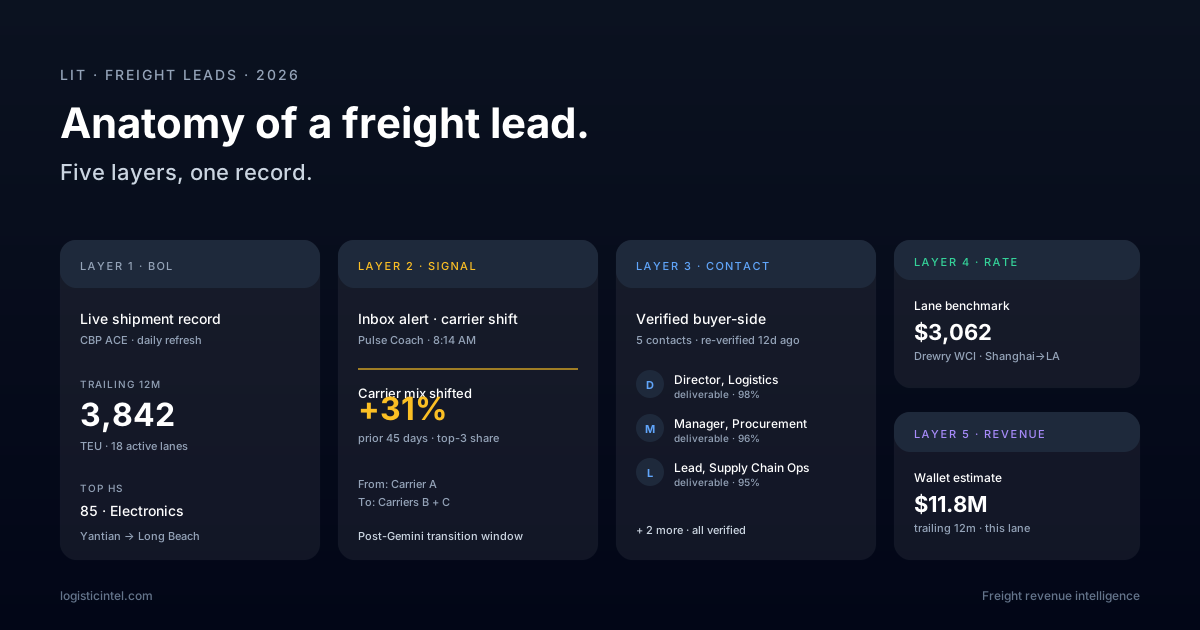
A freight lead is no longer a row in a spreadsheet. In 2026 it is a shipper whose live Bill of Lading activity, real-time market signals, verified buyer-side contacts, benchmark rate exposure, and revenue opportunity together justify a conversation this week. Five layers, one record. This guide unpacks each one, names the data sources behind it, and shows where the public-data ceiling sits before commercial platforms add the workflow.
Demo on your top 3 lanes — we'll show you the saved-company workflow against your actual book of business.
What changed about 'freight leads' since 2024
Three years ago, most freight sales teams worked off the same three lead inputs: a static shipper list bought from a vendor, a generic firmographic database, and a customs-data tool used for occasional lookups. None of those tools talked to each other, and the trade graph underneath them was stable enough that a year-old list still pointed at companies who actually had freight to move.
That trade graph has been rewritten. The Red Sea attacks that began in late 2023 pushed 30%+ of Asia–Europe container traffic around the Cape of Good Hope. Section 321 de minimis was suspended for commercial e-commerce in May 2025 and the One Big Beautiful Bill Act expanded the suspension globally in August. The FMC vacated 46 C.F.R. 541.4 in September 2025, removing the bright-line restriction on D&D billed parties. The Maersk–Hapag-Lloyd Gemini Cooperation launched on February 1, 2025; Sea-Intelligence's tracking has had Gemini at or near the top of trans-Pacific reliability through 2025. Every one of those events shifted who is shipping what, from where, on which carrier. The 2023 shipper list still names the same companies, but most of them are running a different freight setup today than the day the list was built.
Which means the definition of a freight lead had to change with it. A name and an email is the floor, not the ceiling. The teams winning new freight business in 2026 work from a layered record — not a list.
The 2026 anatomy of a freight lead — five layers worth the click
Each layer is independently sourceable; the strategic advantage comes from joining them into a single record before the first outreach. Built in order, each one increases the probability that the email gets read, the call gets answered, and the freight moves.
1. Live shipment activity (the Bill of Lading layer)
The foundation. Every commercial ocean shipment entering the United States is filed with US Customs and made available through the ACE portal. Each filing names the shipper, consignee, origin and destination ports, container count, weight, declared customs value, and HS-classified product category. Similar customs datasets exist across 60+ countries with varying lag and granularity. What turns the underlying records into useful leads is the refresh cadence (daily vs. weekly vs. quarterly), the de-duplication of related entities, and the joinability to the layers below.
Public ACE data is free. The cost of using it for prospecting at scale shows up downstream: schema cleanup, entity resolution, deliverability verification on derived contacts, and the engineering to join customs records to the rest of the picture. Most freight teams find the time and engineering cost outweighs the license savings even at small scale.
2. Real-time market signals (inbox alerts on movement)
A shipment record is a snapshot. A signal is a delta. Three deltas separate stale lists from currently-relevant prospects:
- Carrier-mix pivots: a 25%+ change in an importer's top-three carrier share inside 60 days. The signal that allocation was lost, a contract is up, or service got bad enough to drive change.
- Volume swings: month-over-month volume up or down 20%+. Spikes signal a new program, sourcing shift, or surge — capacity decisions are being made. Drops signal contracted volume moving away from somebody, which is somebody else's opening.
- New-lane activity: a port of entry that wasn't in the shipper's pattern showing up in the last 60 days. The supply chain just got reorganized by someone, often under deadline pressure.
The reason these matter is timing. The buyer who is happy with their current setup ignores your best email. The buyer whose freight got reshuffled last week reads three. Same product, same outreach — different week, different outcome. Signal-triggered sequences in customer campaigns convert at materially higher reply rates than cold lists for exactly this reason.
3. Validated and enriched buyer-side contacts
A shipper without a contact is a research result, not a lead. The useful buyer-side contact graph for freight maps each importer against a stable set of personas: procurement, supply-chain operations, logistics and imports, freight operations, customs, trade compliance, warehouse/DC, and freight finance. Not every shipper has every persona — a $20M brand will not have a dedicated trade compliance analyst — but the map is the same.
What makes a contact validated is a continuous deliverability-verification pass. A contact verified once at the moment of sale and never re-checked decays. A contact whose mailbox is re-validated every 30 days holds the line above 95% deliverability — which is the difference between a campaign that scales and one that gets sandboxed by the sending-domain reputation system. Generic firmographic databases sell job titles; freight prospecting demands the title-plus-context combination, plus the freshness discipline.
4. Benchmark rates on the lane
Knowing who the shipper is and what their freight setup looks like is only useful if you also know the rate environment they are operating against. Public indices anchor that picture. Drewry's World Container Index composite sat at $2,286 per 40-foot container on May 7, 2026, with Shanghai–Los Angeles at $3,062. Lloyd's List reported the SCFI Shanghai–USWC rate hit $1,460 per TEU, the lowest level since July 2023. Newbuilding deliveries decline modestly to 1.7M TEU in 2026 from 2.1M in 2025, but climb to 2.8M TEU in 2027 and 3.5M in 2028 — the supply-side pressure on rates is structural, not seasonal.
For a freight rep walking into a conversation, the question is not what the WCI prints. The question is what the carrier is quoting on the rep's specific lane against what a comparable shipper is paying — which is the gap that benchmark data closes. A shipper whose contract rate is 20% above the lane average is a different conversation than one paying at parity. A lane in a 5%-per-week swing is a different conversation than one in a $50 band. The rate context goes in the briefing or the briefing is incomplete.
5. Revenue opportunity at the account level
The final layer. A shipper running 4,000 TEU through a single lane is a different opportunity than one running 40 TEU spread across 12 lanes, even if both look identical in the contact database. Revenue opportunity translates trailing 12-month shipment volume, declared customs value, and lane mix into an estimated freight wallet — the dollar figure the conversation is fighting over. Without it, prospecting is an exercise in calling everyone the same way. With it, the rep prioritizes the accounts where the upside justifies the time.
The wallet estimate is not a quote. It is a sizing input that tells the rep whether the account is worth a 30-minute discovery call or a 5-minute screening call — and whether the offer should lead with capacity, with rate, or with consolidation.
Where public data ends and platforms begin
Each of the five layers is independently sourceable from public or near-public data: CBP ACE for BOL, BTS and Census trade datasets for macro flows, public Drewry and Freightos indices for rates, LinkedIn and public filings for contacts. The work is the joinability. Stitching the five layers into a single record per shipper, refreshing each layer at the right cadence, and routing the deltas to the rep who saved the account — that is the engineering and operations gap that commercial platforms fill.
The other useful ceiling is workflow. Even a perfectly joined record is inert if the rep has to copy it into a CRM, then into a sequence tool, then into a dialer. The number of tools traversed per outbound action is the silent pipeline tax — measured in customer studies at 2–4 hours per rep per day.
What a freight rep actually does with all this before the first call
An example. A broker covering trans-Pacific gets a Tuesday-morning inbox alert: an importer they saved last quarter has shifted 31% of their top-three carrier share over the prior 45 days, swinging away from Carrier A and toward Carriers B and C. The alert carries the prior 90-day delta and a one-line context note: carrier-mix shift inside the post-Gemini transition window.
Click into the account. The shipper's full record is there: trailing 12-month TEU (3,800), top three carriers before and after the shift, top origin port (Yantian) with two new origin port additions in the last 60 days, top HS-code category, monthly volume curve, lane benchmark rate against Drewry's WCI, and a wallet estimate. Five verified contacts — Director of Logistics, Senior Procurement Manager, Supply Chain Operations Lead, Customs Manager, VP Supply Chain — with email deliverability re-verified in the past 12 days.
The rep drops the Director of Logistics into a six-step sequence. The opening line is the carrier-mix observation — not 'just checking in' — because that is what the buyer is actually thinking about this week. The third-step email references the new origin port activity. The whole sequence takes 12 minutes to launch from inbox alert to first message sent. The buyer reads three of the six emails and books a 30-minute discovery call. The carrier-shift signal that made the difference was filed publicly two weeks earlier; the rep saw it on Tuesday because the system was watching.
That is what 'freight lead' means in 2026. Not a row. A live record with five layers that change.
FAQ
What is the difference between a freight lead and a shipper lead?
Freight leads is the broader term — any company whose freight you can win, across importers, exporters, and shippers in any mode. Shipper leads is the narrower term most freight brokers use for asset-light truckload and intermodal prospecting. Both share the same anatomy: live shipment activity, signals, validated contacts, rate benchmark, and revenue opportunity.
Can I generate freight leads from free public data?
Yes, with caveats. CBP ACE data is free and authoritative for US ocean imports. BTS publishes aggregated trade datasets. Drewry and Freightos publish public rate indices. What is not free is the engineering work to clean, dedupe, and join the data — plus the contact graph and the deliverability verification, which are licensed inputs. Most freight teams find the in-house build cost is higher than the platform cost at any reasonable scale.
How fresh does shipment data need to be for freight prospecting?
Fresher than most static lists, less frequent than tick-by-tick. Daily refresh is the working standard for BOL data in 2026 because the signal deltas — carrier pivots, volume swings, new-lane activity — happen on weekly cadences and need to land before the contract resets. Monthly refresh misses most of the actionable window.
What contact roles matter most for freight outbound?
Depends on the play. Carrier-pivot pitches typically land best with logistics operations or freight operations leads who feel the service problem first. Lane-consolidation pitches go to procurement. RFP-cycle pitches go to supply-chain VPs. The persona match is the difference between an opener that reads as relevant and one that reads as generic.
How do rate benchmarks help in the freight prospecting conversation?
They move the conversation from generic ('we can save you money') to specific ('your current contract is approximately X% above the lane benchmark this week'). The specificity does two things — it signals the rep did the work, and it gives the buyer a number to react to rather than a vague claim.
Is a static shipper list ever worth buying in 2026?
Rarely for sustained outbound. Static lists make sense as a one-time research input for a specific question — 'who imports this HS code from this country' — but the freight graph moves too fast for the same list to be useful three months later. The math that worked in 2019 stopped working when tariffs, alliance reshuffles, and de minimis policy started changing the trade graph quarterly.
Where to take this next
The five-layer definition is a useful diagnostic for any freight prospecting motion. The questions to ask of your current stack are mechanical: how fresh is the shipment data, what signals are watched and how, who is the contact graph for, how is the rate environment surfaced per lane, and how is revenue opportunity sized per account.
If you want to see what those five layers look like joined on a specific account, open the LIT importer directory and pick any name from the 3,508-importer substantive cohort — Samsung, Costco, Home Depot, or any other. The full record is public. The five layers are visible in 90 seconds. The next step, if useful, is a 30-minute walkthrough on your real target lanes — we pull up your top five accounts and show which are actively shipping right now.
And if you only have five minutes, the place to start is the lane page — because the lane is the unit that ties the five layers together for the accounts you actually sell into.