Supply Chain

What 26,787 active US importers tell us about the 2026 sourcing landscape

Our directory tracks 26,787 active US importers across 61 industries with $59.3B in declared customs value. Here's what the live BOL data shows about where the volume sits today — paired with US Census and Port of LA stats for the full market context.

G
Gabriel K.
May 9, 20267 min read
ShareXLinkedInemail
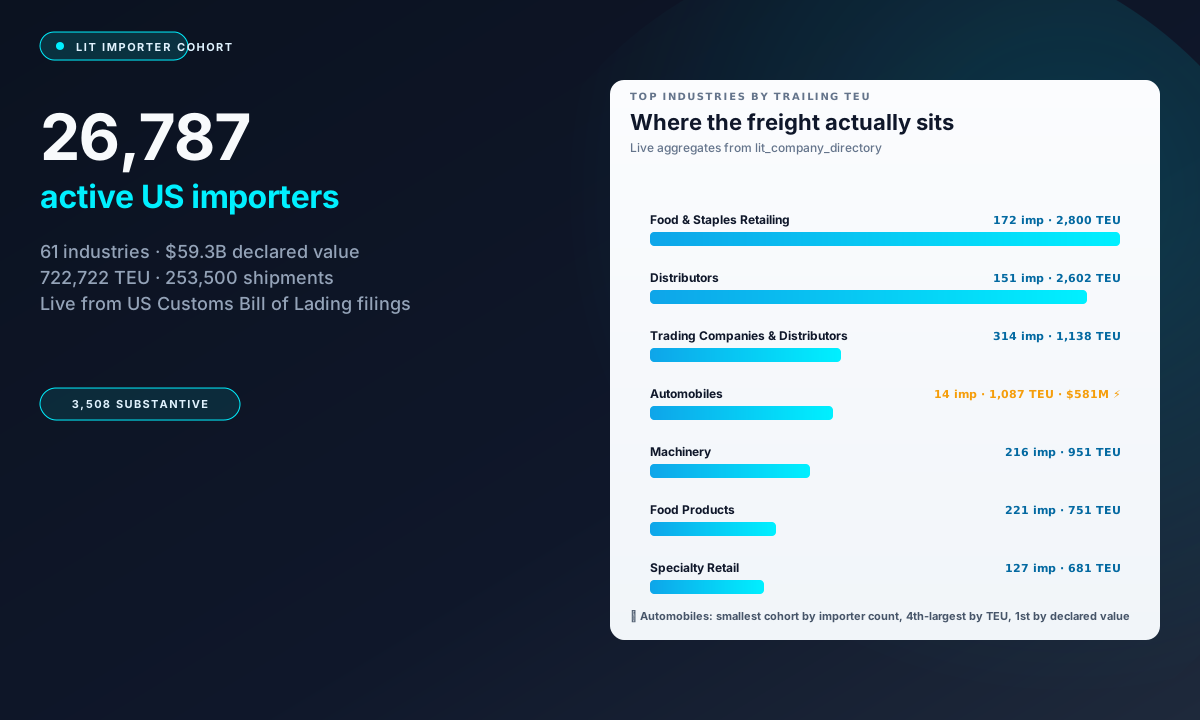
Bar chart comparing TEU volume across major trade lanes for the LIT importer cohort, with industry breakdown

When we describe LIT's data, we should describe it accurately. Our directory tracks 26,787 active US importers — companies that filed at least one ocean Bill of Lading in the trailing 24 months. Across that cohort: 253,500 ocean shipments, 722,722 TEU, $59.3 billion in declared customs value, 61 distinct industries. The substantive subset — importers with 10 or more BOL filings — is 3,508 companies. The heavy subset, 100 or more filings, is 338 companies.

Those are the verifiable LIT numbers. For market-wide context the US Census Bureau, Port of Los Angeles, and Drewry remain the reference sources — we'll cite them inline below. What this piece does is layer our cohort's pattern against those reference points so freight sales teams can see what is moving and what is not.

Where the volume actually sits today

Inside the LIT cohort the top industries by trailing TEU are Food and Staples Retailing (172 importers, 2,800 TEU, $72M declared), Distributors (151 importers, 2,602 TEU, $67M), Trading Companies and Distributors (314 importers, 1,138 TEU, $152M), Automobiles (14 importers, 1,087 TEU, $581M), and Machinery (216 importers, 951 TEU, $84M).

The interesting line is automobiles. Fourteen importers, the smallest cohort in our top-five list, are running the fourth-highest TEU — and far and away the highest declared value at $581M. That is the operating economics of containerized auto parts: heavy, dense, expensive, and concentrated in a small set of OEM and tier-one shippers. If your freight desk is targeting the auto vertical, your prospect list should be 15–20 names long, not 200.

Where the LIT cohort fits inside the total market

The US imports roughly 24–26 million TEU per year through its container ports (Port of Los Angeles plus Port of Long Beach alone handled 19.4M TEU in calendar 2024, per their joint monthly reports). The LIT directory captures a substantive operating subset of those filings — not every shipment, but enough of the active importer base to give you operator-grade depth on the buyers your team will actually call. Read it as a high-quality sampling frame, not the full universe.

What the external reference points say about 2026

Three reference points are worth keeping in mind when reading the LIT cohort: the US Census Bureau's FT-900 trade release shows the value-side trend (running monthly), Port of Los Angeles publishes its monthly TEU dashboard mid-month for the prior month, and Drewry's World Container Index gives the spot-rate read on the major trans-Pacific and Asia→Europe lanes. None of those replace your own pipeline judgment. Together they tell you whether the buyer behavior you're seeing is part of a market story or a one-account quirk.

Through Q1 2026, Drewry's WCI has held in a tighter band than Q1 2024 — a market signal that allocation discipline is back, not capacity scarcity. If you're pitching importers in our cohort, the Q1 environment is one where contracted relationships dominate and spot exposure is limited. That favors freight forwarders selling reliability over pure-price brokers.

How to actually use this

Open the /companies hub, sort by industry, and pull the top 25 importers in the vertical your team is targeting. Each profile carries the same shipment data we aggregated above. The brief on each one (Pulse AI) takes about 90 seconds to read. By the end of an hour you'll have read 25 substantive briefs in a single vertical and you'll know which 5 you want to call this week. That is the loop. The cohort is real. The numbers in this piece are real. The next move is yours.

ShareXLinkedInemail
Get Started

See LIT in action.

Book a 30-minute demo with the team. We'll show you the platform live with your accounts.