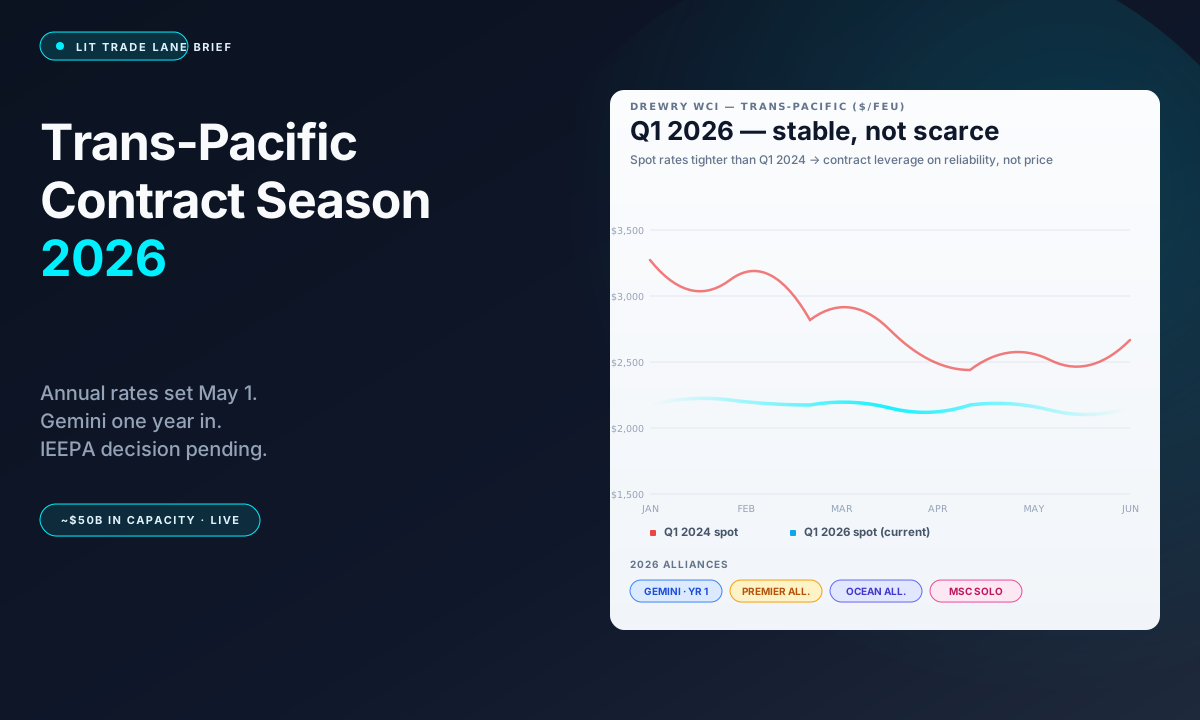
The 26th annual Trans-Pacific Maritime Conference wrapped in Long Beach earlier this month, kicking off the negotiation window that sets nearly two-thirds of US-bound containerized freight on annual contracts for the year ahead. Rates take effect May 1. The conversations between Beneficial Cargo Owners and ocean carriers between now and then will allocate close to $50 billion of capacity. Three things make this contract season unusual.
Gemini Cooperation has a year of data behind it
Demo on your top 3 lanes — we'll show you the saved-company workflow against your actual book of business.
When Maersk and Hapag-Lloyd launched the Gemini Cooperation on February 1, 2025, the alliance staked its pitch on schedule reliability — a promise of 90%+ on-time performance built around a hub-and-spoke routing network. Twelve months in, the data largely backs the promise. Sea-Intelligence's monthly Global Liner Performance reports placed Gemini at or near the top of trans-Pacific reliability through 2025. BCOs that committed early are walking into TPM 2026 with a renewal conversation. BCOs that didn't are deciding whether to switch.
The IEEPA tariff overhang remains unresolved
The Supreme Court heard oral arguments in V.O.S. Selections v. United States in November 2025, with a decision expected by early summer 2026. The case challenges the use of the International Emergency Economic Powers Act to impose broad import tariffs. A ruling against the administration could trigger refunds for affected importers. A ruling in favor would lock in the current tariff stack. Either outcome lands inside the contract-signing window, and BCOs are pricing both scenarios into their carrier negotiations through hedge clauses and shorter contract terms than the historical norm.
Spot rates are stable, not scarce
Drewry's World Container Index has held in a tighter band through Q1 2026 than it did in Q1 2024, when post–Red Sea diversions were still working through the system. The rebound is mature. Allocation discipline is back. Carriers are unlikely to give meaningful concessions on contract rates this round — which means the leverage in this year's negotiations sits more on service reliability than on price.
Who is actually switching
US Customs Bill of Lading data through the first quarter shows a partial reshuffling. Across the 3,508 substantive importers tracked in the public LIT directory — importers with 10 or more BOL filings in the trailing 24 months — roughly one in three had a measurable carrier-mix change in the prior 90 days, defined as a 25%+ swing in their top-three carrier share. That cohort is the one to watch. Some are completing the post-Gemini transition. Some are testing alternatives before the May 1 contract resets. All of them are reachable.
The importers most likely to switch this season are the ones who didn't move in 2025. If a shipper signed a one-year 2025 contract with a non-Gemini carrier and reliability fell short, this is the contract season they renegotiate. If they signed with Gemini in 2025 and reliability held, they renew. The middle case — BCOs who held their existing relationships and are watching the data — is where most of the live negotiations sit through April.
Reading any one importer's exposure
For sellers who want to walk into a specific BCO meeting prepared, the Pulse AI account brief on every importer profile inside LIT compresses the public BOL record into a one-page read: trailing 12-month TEU, container mix, top trade lanes, and any carrier-mix change over the prior 60 days, alongside flagged opportunity signals like forwarder displacement or supplier diversification. The brief takes about ninety seconds to read and points to the contract-renewal angle when one exists. That is the kind of preparation a TPM-season conversation rewards.
The bigger picture
Trans-Pacific contract season is not a one-week event. It is a three-month conversation that started at TPM and runs through May 1. The shippers worth chasing this year are the ones whose lane mix changed between January and April — the ones with an open seat at the carrier negotiation table and a real reason to listen. Find them. Read the data. Have the right thing to say when you reach out.