Every freight sales team eventually runs into the same wall. You found the right shipper. You can describe their lane mix, their carrier share, their seasonal volume curve. You cannot find the buyer. You don't know if procurement runs freight or if supply chain does, you can't tell which of the four people with the right title actually has the budget, and the email you ended up sending bounces.
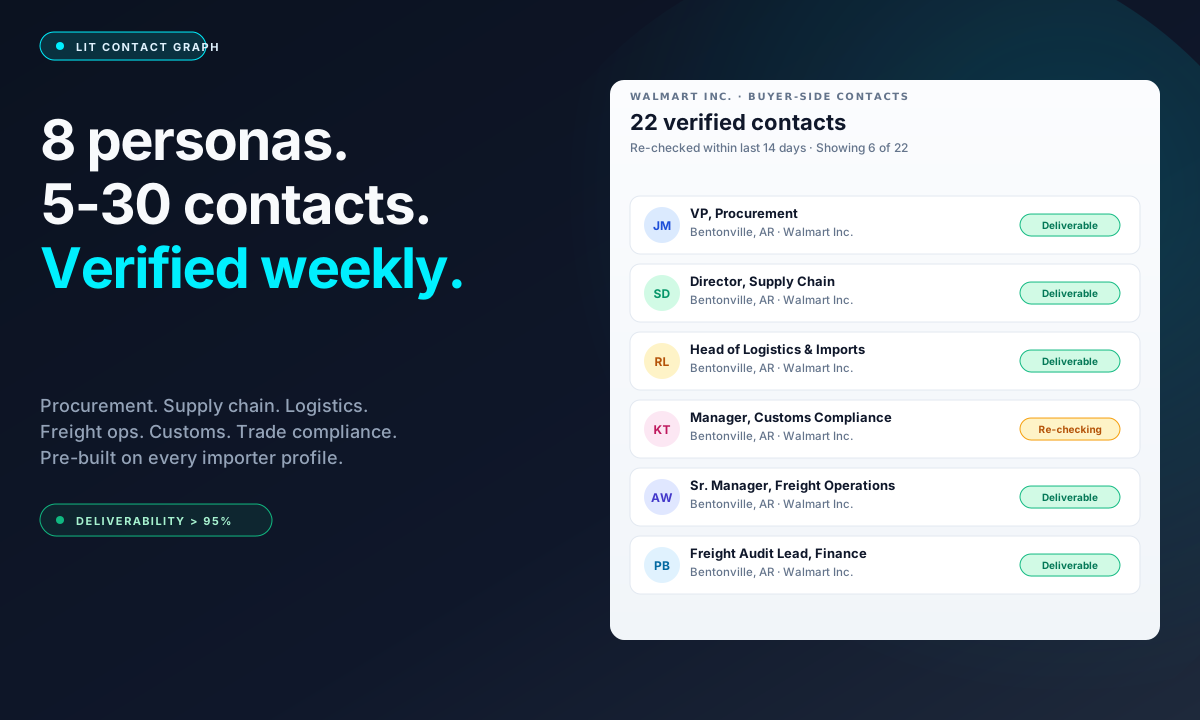
The contact graph is how we close that loop. Every importer in LIT carries 5–30 pre-built, role-tagged, deliverability-verified contacts — sourced and refreshed weekly. This is how it works.
Demo on your top 3 lanes — we'll show you the saved-company workflow against your actual book of business.
Eight personas, mapped per company
We map each importer against a stable set of buyer-side personas. Procurement, supply chain operations, logistics and imports, freight operations, customs, trade compliance, warehouse and DC, and freight finance / audit. Not every importer has every persona — a $20M brand will not have a dedicated trade compliance analyst — but the map is the same. Knowing which persona owns the freight decision at this importer changes the opening line of your email.
How we source them
Three layers. Public company filings and LinkedIn enrichment are the first layer — fastest to refresh, least durable. A licensed professional contact graph forms the second layer; this is where the bulk of titles, work emails, and direct dials come from. The third layer is where most providers stop and we don't: a continuous deliverability-verification pass that re-validates every email at least every 30 days. If a contact's deliverability drops, they roll out of the active set until we can re-confirm.
What 95%+ deliverability buys you
The math is unromantic. If your sender reputation cracks because too many emails bounced, you stop landing in the inbox for the contacts you didn't burn. A team running cold outreach on 80%-deliverable lists is one Monday away from getting their domain throttled. Holding the line above 95% is not a marketing claim; it is the difference between a campaign that scales and one that gets sandboxed.
How the graph plugs into outbound
Inside an LIT account profile, the contact pane sits next to the shipment intelligence. You pick the persona that fits the play (carrier pivot pitch → freight ops; lane consolidation pitch → procurement). The contacts come pre-ranked by seniority and our internal recency score. Pulse AI uses the same graph when it drafts a multi-step sequence — so if the sequence opens at procurement and follow-ups at logistics, those two contacts are real people whose roles match the email body. That coherence is what makes the sequence read like a sales rep, not a spam cannon.
Why we built it this way
Freight teams should not be running three tools to find a buyer at a shipper they already understand. The shipment graph and the contact graph are two halves of the same answer. We built them under one roof because that is how the work actually flows: pick the account, pick the persona, write the message that fits both. Anything that splits those three steps adds friction to the only part of the day that matters — getting a reply.