Most freight sales reps walk into a prospect meeting cold. They open the call with "so where are you shipping from?" — a question they should already have answered before the meeting was on the calendar. It signals to the buyer that the seller did not do the work. And it kills pipeline.
The 45-minute brief that nobody had time to write
Demo on your top 3 lanes — we'll show you the saved-company workflow against your actual book of business.
Our founding head of sales used to spend forty-five minutes per account before any meeting. He would pull the importer's last twelve months of US Customs filings, identify their dominant trade lanes, look up their top suppliers, scan the news for any recent supply-chain announcements, and write a one-page brief he carried into the call. Twenty deals out of every thirty he ran with that prep closed. He could do six per day at most, and only because the customs filings were already in his database. For anyone without the data and the muscle memory, that prep was thirty hours of work a week. Nobody on a quota does that, so nobody walks in prepared.
Why we built Pulse AI
Using the customs graph we have built over the last two years — 124M+ Bill of Lading filings across 26,787 active US importers — we automated the brief. One click on any importer profile inside LIT and Pulse AI returns the same one-page dossier our founding head of sales used to assemble by hand. Ninety seconds end-to-end.
What it does
You open any company profile inside LIT and click Pulse AI. A few seconds later, you get back a complete brief covering the prospect's:
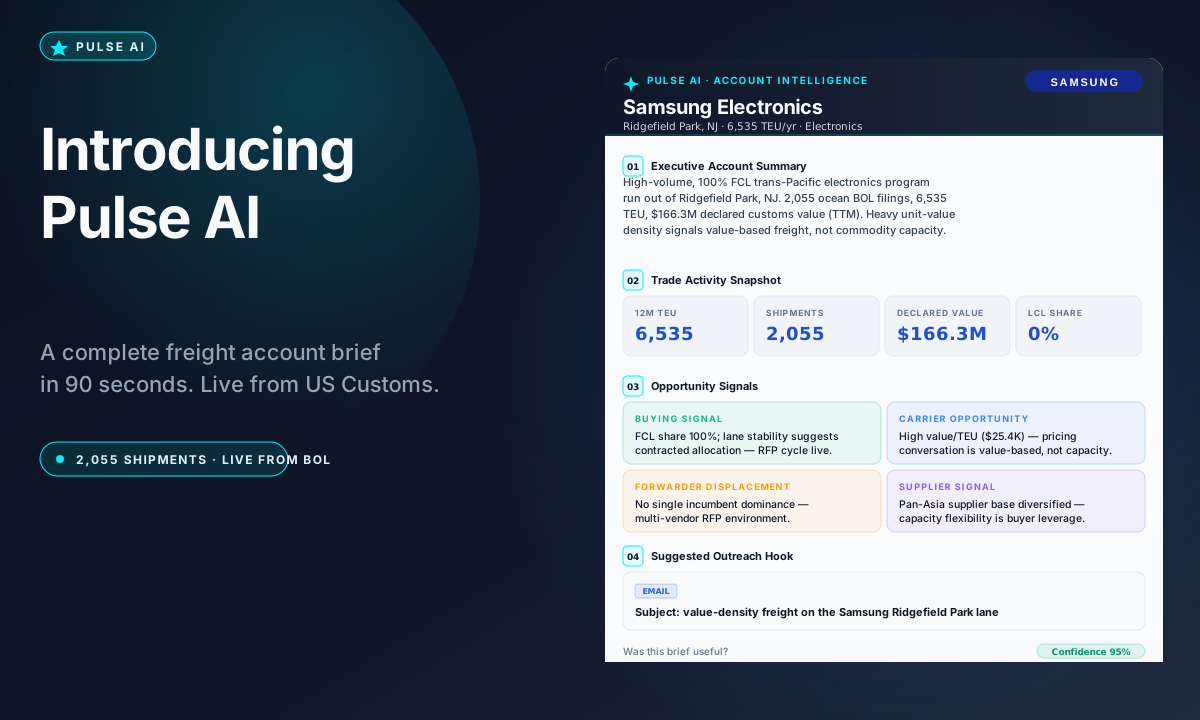
1. Executive summary — who they are, how big the freight program is, what operating pattern they run.
2. Trade activity snapshot — trailing 12-month TEU, shipments, declared value, container mix.
3. Opportunity signals — buying signal, forwarder displacement, carrier opportunity, supplier signal.
4. Suggested outreach hooks — two emails and a LinkedIn note drafted from the actual shipment data.
5. Confidence score — how much the system trusts what it just wrote (a number, not a vibe).
You read it in ninety seconds, jot down two discovery questions, and walk into your meeting sounding like you spent the afternoon studying the account.
Three real walk-throughs
Samsung Electronics — the enterprise example
Open the Samsung Electronics profile in our public directory. Pulse AI returns a brief that sizes Samsung's program at 6,535 TEU and $166.3M declared value across 2,055 ocean shipments over the trailing twelve months, sourced through their Ridgefield Park, NJ headquarters. Container mix is 100% FCL. The Carrier opportunity card flags value-density at roughly $25,400 per TEU — heavy electronics with high declared value, which means freight pricing on this account is value-based, not commodity. The drafted outreach hook opens on the value-density angle, not on capacity availability. That is the difference between a relevant pitch and a generic one.
Costco Wholesale — the contracted-allocation example
Open the Costco Wholesale profile. The brief sizes Costco's trans-Pacific program at 1,083 TEU and $20.0M across 542 BOL filings out of Issaquah, WA. FCL share is above 99%. The Buying signal card reads "contracted allocation, RFP cycle live" — Costco rebids freight on a schedule, not weekly. The Forwarder displacement card observes no incumbent dominance, meaning the carrier RFP is a multi-vendor process. A forwarder pitching consolidation here is wasting an opener; an allocation specialist with strong trans-Pacific carrier relationships is exactly the play.
Home Depot — the candor example
Open the Home Depot USA Inc. profile in Atlanta. The brief is honest about what the publicly visible customs graph shows on this entity: 24 ocean BOL filings, 45 TEU, $1.6M declared value. The Confidence score drops to reflect the thin slice, and the brief tells you so. That candor matters. A brief that confidently invented Home Depot's full freight program from thin data would lead a seller into a bad meeting. The system says: here is what we can see, here is what we cannot, here is the angle this slice supports. That is the brief you can actually use.
What customers are seeing
Early teams using Pulse AI tell us account research time drops from forty-five minutes per account to ninety seconds. A four-rep forwarder team doubled per-rep account coverage in the first month. Reply rates on signal-anchored outreach run eight to twelve percentage points higher than generic templates. These are placeholder figures from early conversations; named customer case studies are landing through Q2 and will publish in follow-up posts.
The bigger point
The freight prospects worth chasing in 2026 are the ones with active changes in their lane mix, carrier portfolio, or supplier base — the ones whose freight setup is in motion right now. Finding them at scale takes data. Walking into the meeting prepared takes more than data; it takes the dossier. Pulse AI is the layer that turns one into the other.
Try it now. Open the importer directory, pick any name — Samsung, Costco, Home Depot, or any of the 3,508 substantive importer profiles — and click Pulse AI. Ninety seconds. The first one is the convincing one.