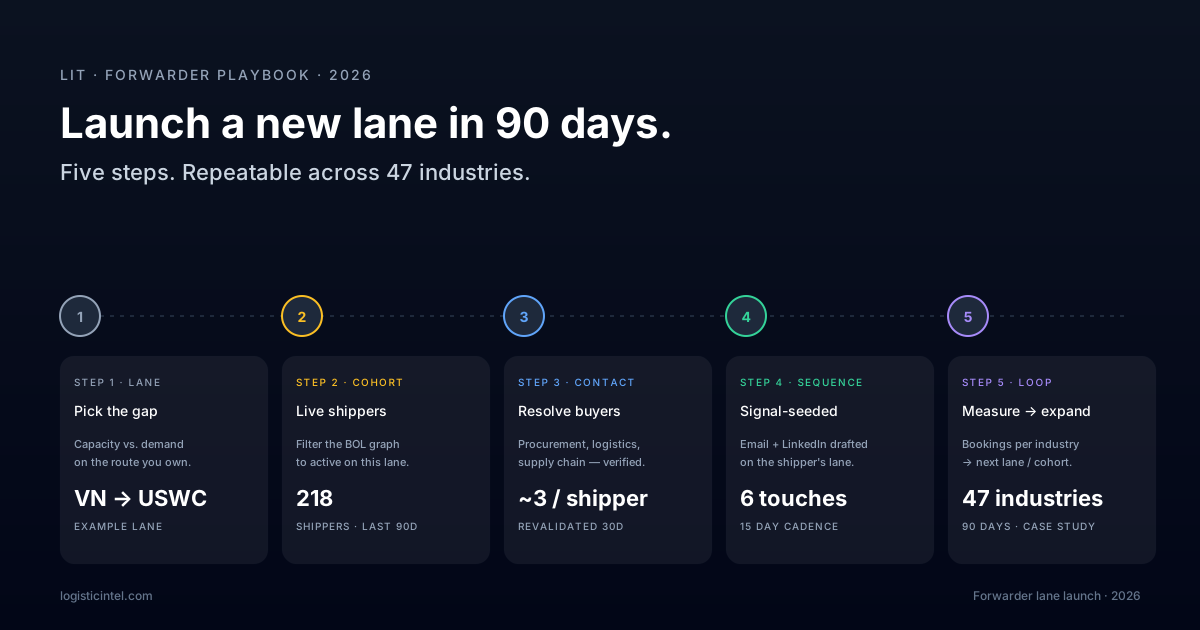
TL;DR
The lane-launch playbook is how modern freight forwarders find new accounts without buying lead lists. Pick a lane you can already operate, pull the live cohort of shippers moving freight on it, resolve buyer-side contacts at each account, and launch a six-step outreach sequence seeded with each account's specific carrier mix and volume. One forwarder built nine months of pipeline in 90 days this way. The steps work for any lane; the leverage is in compressing the research-to-conversation cycle from three hours to twenty minutes per industry.
Demo on your top 3 lanes — we'll show you the saved-company workflow against your actual book of business.
Why the 2018 forwarder playbook stopped working
Three years ago the standard motion went like this: pull a list of importers from a vendor, send the same email to every name, and hope 1% replied. The math held because the trade graph was stable — accounts shipping a year ago were probably still shipping the same way.
That math doesn't hold anymore. The Red Sea reroute, IEEPA tariffs, the Section 321 de minimis suspension, the Gemini alliance launch, and the LA/Long Beach drayage capacity squeeze — every quarterly trade event has rewritten which shippers actually need a forwarder this month versus which ones are locked into contracts that won't move. The forwarder playbook had to follow.
What replaced the old motion isn't more research. It's better timing — built around the specific lane being attacked, not the universe of all possible accounts.
The lane-launch playbook in five steps
A repeatable 90-day cycle. Run it on one lane, then expand to adjacent lanes once the first sequence proves out. Pegasus Logistics scaled this across 47 industries in a single quarter using the same five steps below.
Step 1: Pick the lane
The first decision is geographic, not vertical. Pick a lane your team can already operate — Vietnam to US East Coast, Mexico to the US Southwest, India to the US East Coast, whatever corridor where your carrier relationships and customs experience are real. Vertical depth comes in step 2; lane discipline comes in step 1.
The lane is the unit because the carrier relationships are lane-specific, the buyer's decision is lane-specific (shippers don't pick a forwarder, they pick a forwarder for a specific corridor), and the data is lane-specific. Avoid the 'we work all lanes' framing in step 1. It's true at the company level but never at the rep level.
Step 2: Pull the live shipper cohort
With the lane chosen, the next move is identifying the importers actively moving freight on it. The data source is public US Customs Bill of Lading filings, filtered to the lane and to the last 90 days of activity. The query language matters: you don't want 'all importers from Vietnam,' you want 'Vietnam to US East Coast importers, FCL volume 20+ TEU trailing quarter, in furniture, apparel, or electronics.' Each filter narrows the cohort to accounts where a forwarder pitch is viable.
For most lanes the right cohort size is 100–250 named accounts. Smaller than that and you exhaust the list in week 2; larger and the sequence loses the personalization that makes it convert.
Step 3: Resolve buyer-side contacts
Once the cohort is built, each account needs the right person inside it. The eight buyer-side personas freight forwarders typically reach are procurement, supply-chain operations, logistics and imports, freight operations, customs, trade compliance, warehouse/DC operations, and freight finance.
Not every account has every persona. A $40M shipper running 200 TEU/year probably has one Director of Logistics doing everything; a $2B shipper has all eight broken out. The persona match is the play — lane-consolidation pitches go to procurement, carrier-pivot pitches go to logistics operations, RFP-cycle pitches go to supply-chain VPs, customs clearance pitches go to trade compliance.
The contact data needs to be deliverability-verified within 30 days. Without that discipline the campaign burns through the sending domain's reputation in week 2 and the second half of the cohort never sees the message.
Step 4: Build the lane-launch sequence
The sequence has six touches over 11 days. The opening line in each touch is the lane signal — what changed in that account's freight activity recently — not the forwarder's pitch. A working template:
- Day 1, email: 'Your Vietnam volume is up 31% this quarter. Couple of thoughts on the lane.'
- Day 3, LinkedIn invite: a one-line context note about the lane.
- Day 5, email: a specific data point about the lane — carrier reliability, port congestion, rate movement.
- Day 7, call task: phone outreach with a discovery question tied to the carrier mix.
- Day 9, email: a case-study reference about a comparable shipper.
- Day 11, email: break-up — 'If now's not the right week, here's what I'd flag to watch on this lane.'
The volume math works at this cadence: 100 accounts × 6 touches × 11 days = 660 sends over the launch window. One rep can run two lanes in parallel — about 1,300 outbound touches per fortnight. Reply rates on signal-seeded sequences typically run 3–8 points higher than cold lists in customer programs.
Step 5: Measure, iterate, expand
At day 21 the sequence has finished and replies have come in. The team measures three things: reply rate by persona (which titles converted), reply rate by signal type (carrier pivot vs. volume swing vs. new-lane activity), and deal velocity (how many replies became discovery calls within 14 days).
The patterns from the first lane inform the next. If carrier-pivot opens converted 2× the volume-swing opens, the next lane leads with carrier signals. If procurement replied 3× more than supply-chain ops, the next lane targets procurement first. The fifth step is what makes this a playbook, not a campaign — by the time the second lane runs, the team knows which personas and signals work for their specific carrier relationships.
Case study: 47 industries in 90 days
Pegasus Logistics ran the playbook above across 47 industry verticals starting in 2025. Their 12-person commercial team had been asked to expand coverage but couldn't hire. The lane-launch playbook compressed their research time from three hours per industry list to twenty minutes per list, and the same six-touch sequence ran across every industry with only the lane data swapped.
Numbers from the third quarter of execution: nine months of forecasted pipeline built in the first 90 days, 3.2× per-rep outbound capacity versus baseline, 47 industries covered without adding headcount. The lane-launch sequence is now Pegasus's standard onboarding playbook for new reps.
The mechanic that made it scale was the standardization of step 2's query language. Once one rep could write a Pulse query for an industry-specific lane cohort, every other rep could clone the pattern.
Common mistakes
Three failure modes show up across forwarder teams trying the playbook for the first time.
1. Starting with vertical, not lane. Reps who pick 'automotive importers' first end up trying to compete on lanes they don't actually operate. The lane discipline in step 1 prevents this.
2. Targeting the wrong persona for the signal. A carrier-pivot signal sent to procurement lands flat; sent to logistics ops it converts. The persona-to-signal map in step 3 is the single highest-leverage decision in the whole playbook.
3. Treating the case-study email (day 9) as a closing email. It's a credibility prompt, not a 'click here to buy' message. Reps who lead with the case study at day 1 burn the prospect's attention before the lane signal has had a chance to register.
FAQ
How long does the playbook take to ship the first lane?
End to end, from 'pick a lane' to 'first reply': 14 days. Steps 1–3 are two days of work; the 11-day sequence runs in parallel with the next lane's prep.
Does this work for cross-border trucking lanes?
Yes, with caveats. US-Mexico and US-Canada cross-border lanes have less detailed public shipment data than ocean lanes, so step 2's cohort-pull is harder. Forwarders running cross-border typically supplement with internal customer history.
What's the minimum cohort size that makes the math work?
50 named accounts. Below that the per-touch cost of personalization eats the leverage. The sweet spot is 100–250.
How many lanes can one rep run at a time?
Two. One launching, one harvesting. A third in research is fine, but four lanes in active outreach causes signal drift and the rep starts mixing up which account got which pitch.
When should we add a new persona to step 3?
After the first three lanes converge on the same two personas working. If procurement and logistics ops are the consistent winners, build the playbook around them. Adding personas before you have signal is over-engineering.
Where to take this next
The five-step playbook is the framework. The leverage sits in compressing each step: from three hours to twenty minutes on step 2, from manual contact lookup to a pre-built persona graph on step 3, from generic copy to signal-seeded openers on step 4. Each compression is independently buildable; the cumulative effect is what scales the team from 'one lane every two weeks' to 'five lanes a week.'
If you want to see what the workflow looks like running end-to-end on a specific lane, the LIT walkthrough is built around this playbook — pick your top five lanes, we pull up the live cohort, the contact graph, and the sequence template in 30 minutes.