
Executive Summary
Demo on your top 3 lanes — we'll show you the saved-company workflow against your actual book of business.
The relevant "US-Mexico agreement" in 2026 is not a brand-new bilateral free trade pact. It is the U.S.-Mexico track of the first six-year joint review of the United States-Mexico-Canada Agreement (USMCA).
USMCA entered into force on July 1, 2020. Article 34.7 requires a joint review on the sixth anniversary, gives the agreement a 16-year term, and allows extension in 16-year increments if the parties confirm they want to continue it.
Washington and Mexico formally launched the review process on March 5, opened technical talks on March 18, and agreed on April 20 to hold the first official bilateral negotiating round during the week of May 25 in Mexico City. On May 22, U.S. Trade Representative Jamieson Greer said the first round would focus on stronger regional rules of origin and economic security.
Why this matters for logistics providers
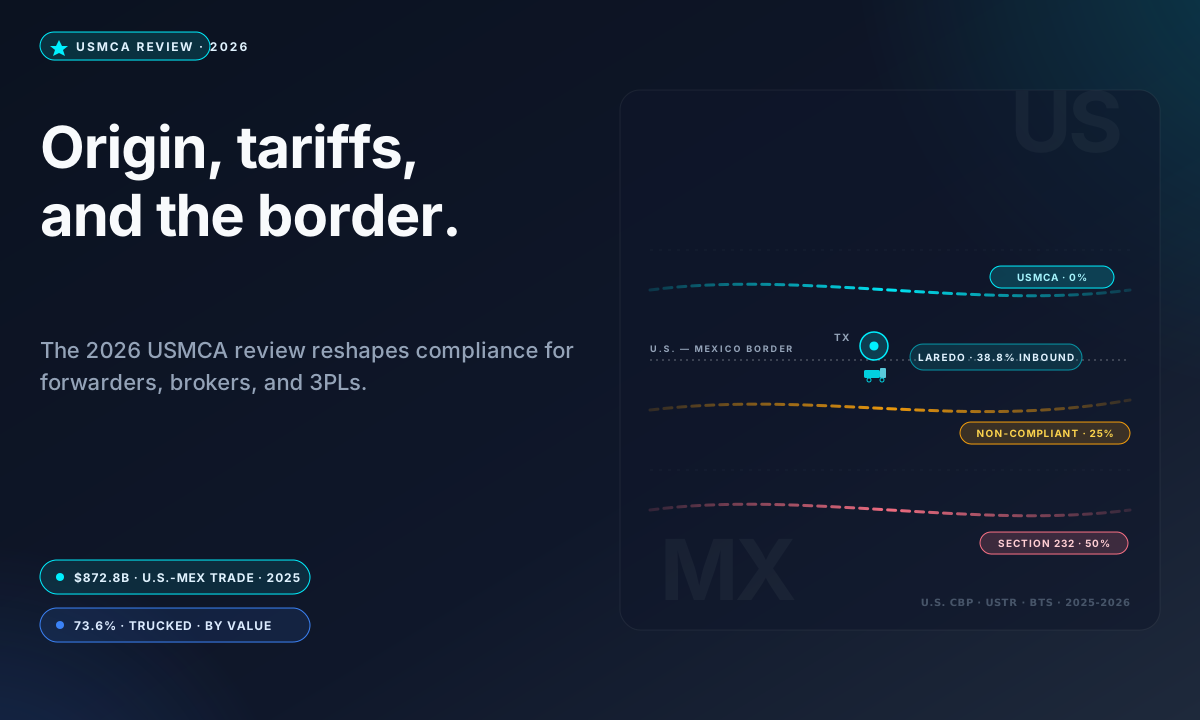
U.S.-Mexico trade is too large to treat the review as background noise. U.S. goods trade with Mexico totaled an estimated $872.8 billion in 2025. Trucks carried 73.6% of that freight by value, and Laredo handled 38.8% of all inbound trucks from Mexico in 2025.
The current U.S. tariff framework makes USMCA qualification a direct landed-cost issue. The White House says USMCA-compliant goods from Mexico continue to receive 0% treatment under the existing Mexico-related IEEPA framework, while non-USMCA-compliant goods generally face 25% duties and certain non-compliant energy and potash 10%.
The review is more likely to produce compliance pressure, repricing, and re-routing than an immediate legal cliff.
Under Article 34.7, if the parties do not all confirm an extension at the six-year review, the agreement does not shut off on July 1, 2026. Instead, the parties move into annual reviews for the remainder of the term unless they later agree to extend it. The short-term supply-chain risk is uncertainty and operational friction — not instant treaty collapse.
What Is Being Reviewed
The base agreement still defines the operating environment. USMCA replaced NAFTA in 2020, preserved preferential tariff treatment for qualifying regional trade, tightened automotive and industrial rules of origin, modernized origin procedures, and added stronger labor and digital trade disciplines.
The four provisions that matter most
- Chapter 4 — governs rules of origin.
- Chapter 5 — governs origin procedures.
- Chapter 7 — requires customs procedures to facilitate import, export, and transit while supporting compliance.
- The automotive package — raised regional value content requirements from NAFTA's 62.5% to 75% for passenger vehicles and light trucks, and added labor value content requirements.
CBP guidance also makes clear that a USMCA claim can be made in any format, provided it contains the nine minimum data elements.
The new operative question for freight
The 2026 review is less about whether free trade exists and more about who gets to use the preference, under what sourcing conditions, and with what enforcement intensity. Washington wants stronger rules of origin, lower exposure to non-market inputs, more alignment on economic security, tighter cooperation on critical minerals, and action on Mexico-specific concerns including energy policy, customs-broker restrictions, and labor enforcement.
What Changed in the Past Week
Negotiating posture, not new legal text
The newest official development is about timing and emphasis, not a published amended text. On May 22, Reuters reported Greer's statement that the first formal negotiations would begin in Mexico City the following week and would focus on strengthening regional content rules and economic security. Mexican officials, speaking separately through the Secretaria de Economia, said formal conversations with the United States would begin on May 27.
Mexico's diversification hedge
A second major development came from outside the formal USMCA track but affects bargaining power. On May 22, Mexico and the European Union signed a long-delayed trade agreement intended in part to diversify away from U.S. exposure amid elevated U.S. tariffs. That does not reduce U.S.-Mexico interdependence in the short run, but it does give Mexico-based manufacturers and exporters a clearer diversification option.
Active labor enforcement, today
A third near-current signal is enforcement continuity. On May 18, USTR invoked the USMCA Rapid Response Labor Mechanism in an alleged denial-of-rights case at the Faurecia Silao auto-parts facility and said the United States had suspended liquidation of unliquidated entries from that facility. The agreement's labor enforcement architecture is already capable of affecting shipments at the plant level while the broader review is underway.
How Trade Flows, Tariffs, and Customs Could Change
The current tariff map
The current tariff map is more complicated than many shippers assume. Under the White House's April 2025 framework:
Separate sectoral measures remain in force outside that broad preference structure. Reuters reported in April that Greer told Mexican auto and steel industries not to expect the USMCA review to remove those sector tariffs. For brokers and forwarders, duty logic has to be built statute by statute, not lane by lane.
Mexico is tightening too
Mexico's 2025-2026 customs and tariff reform raises import duties for roughly 1,463 non-preferential tariff items, increases documentation requirements, strengthens digital monitoring, and places more responsibility on customs brokers. Products receiving preferential treatment under a free trade agreement — including originating products under USMCA — are not subject to those new Mexican tariffs.
The commercial lesson from both sides of the border is the same: origin status is becoming more valuable, not less.
Where the freight pressure lands
The risk is not that U.S.-Mexico volumes suddenly disappear. The risk is that large volumes get repriced, re-documented, and re-routed. Because trucking is the dominant mode and Laredo is the dominant southern truck gateway, modest increases in documentation scrutiny can create outsized pressure on South Texas, El Paso-Ysleta, and Otay Mesa.
Operating Areas Most Likely to Change
1. General tariff treatment
Current baseline. USMCA-compliant goods from Mexico remain at 0% under the current IEEPA framework; non-compliant goods generally face 25%.
Likely direction. The preference is likely preserved, but qualification standards and verification may tighten.
Freight effect. More SKU-level origin audits before booking and customs entry.
2. Steel and aluminum
Current baseline. Section 232 tariffs remain elevated.
Likely direction. No clear sign of rollback; talks may harden anti-circumvention rules.
Freight effect. Continued landed-cost pressure on metals freight and derivative products.
3. Autos and auto parts
Current baseline. USMCA already requires 75% North American content for passenger vehicles and light trucks.
Likely direction. U.S. negotiators are signaling stronger regional-content rules.
Freight effect. More BOM scrutiny, supplier substitutions, and compliance consulting needs.
4. Origin documentation
Current baseline. USMCA claims can use any format but require the nine minimum data elements.
Likely direction. Documentation likely audited more aggressively.
Freight effect. Better-prepared shippers clear faster; weak files face delays.
5. Border processing
Current baseline. Chapter 7 seeks facilitation, but truck corridors remain chokepoints.
Likely direction. Short-term friction likely rises before facilitation gains.
Freight effect. More buffer time and near-border storage for high-risk SKUs.
What It Means for Forwarders, Brokers, and 3PLs
For freight forwarders
The near-term value proposition shifts toward origin intelligence and tariff interpretation. Moving freight between Mexico and the United States in 2026 increasingly requires product-level knowledge of whether a shipment qualifies under USMCA, whether it faces Section 232 exposure, whether a plant or supplier carries labor risk, and whether the Mexican side has the documentation needed to avoid reform-related friction. Forwarders who can translate tariff and origin uncertainty into routing, buffer-stock, and customs-planning guidance will be more valuable than forwarders selling linehaul alone.
For customs brokers
The review is directly commercial. USTR's report to Congress includes restrictions on Mexican customs brokers among its Mexico issues, while Mexico's customs reform increases documentation demands, legal responsibility, and digital oversight. ANAM continues to organize import operations around importer registration and digital tools such as VUCEM and SOIA/SAAI — exporters that still rely on loose invoice descriptions or incomplete product files are more likely to create clearance problems for their Mexican counterparties.
For trucking providers
The legal lane already exists. FMCSA's Mexico Long-Haul Program has, since 2015, allowed approved Mexico-domiciled carriers to operate beyond U.S. border municipalities and commercial zones. The 2026 review is less likely to rewrite basic long-haul access than to alter the compliance and duty economics that determine which loads move, which dwell, and which need pre-clearance-quality paperwork.
For 3PLs and warehouse operators
The most probable short-term change is increased demand for border-buffer capacity. Trucks dominate the lane, Laredo remains the principal truck gateway, Mexican customs documentation controls are tightening, and U.S. negotiators are explicitly targeting origin, economic security, and non-market inputs. That points to more demand for segregated inventory by tariff/origin status, more transload and cross-dock activity near border nodes, and more temporary storage while entries are reconciled.
Fuel and energy flows deserve special attention
USTR's 2026 National Trade Estimate says Mexico's 2025 implementing regulations for the Hydrocarbons Sector Law prohibit certain fuel transloading activities, which decreases logistical flexibility. If energy policy becomes a larger bargaining chip in the review, terminal operators, energy shippers, and warehouse networks tied to fuel movements should plan for continued route and storage redesign.
Compliance Moves to Make Now
The six-move checklist
- Re-qualify USMCA claims at the SKU level, not the customer or lane level.
- Keep origin support packages ready before booking: HS classification rationale, bill of materials, supplier declarations, and sector-specific support such as steel or automotive content records.
- Build a statute-by-statute tariff map covering USMCA, the Mexico-related IEEPA framework, Section 232 metals, and auto/parts measures.
- Review the Mexican side of the file just as hard as the U.S. side: importer registration, invoice detail, valuation records, technical sheets, and permit readiness.
- Add plant-level labor screening for Mexico suppliers in sensitive sectors, especially automotive and auto parts.
- Put deliberate time and inventory buffers around Laredo, El Paso-Ysleta, and Otay Mesa for high-risk product families.
That checklist follows directly from current CBP guidance, White House tariff actions, Mexico's customs reform, active RRM enforcement, and the physical concentration of truck traffic on the southern border.
Visual Workflow: USMCA Cross-Border Compliance Flow
→ Open the full USMCA cross-border compliance workflow diagram (SVG).
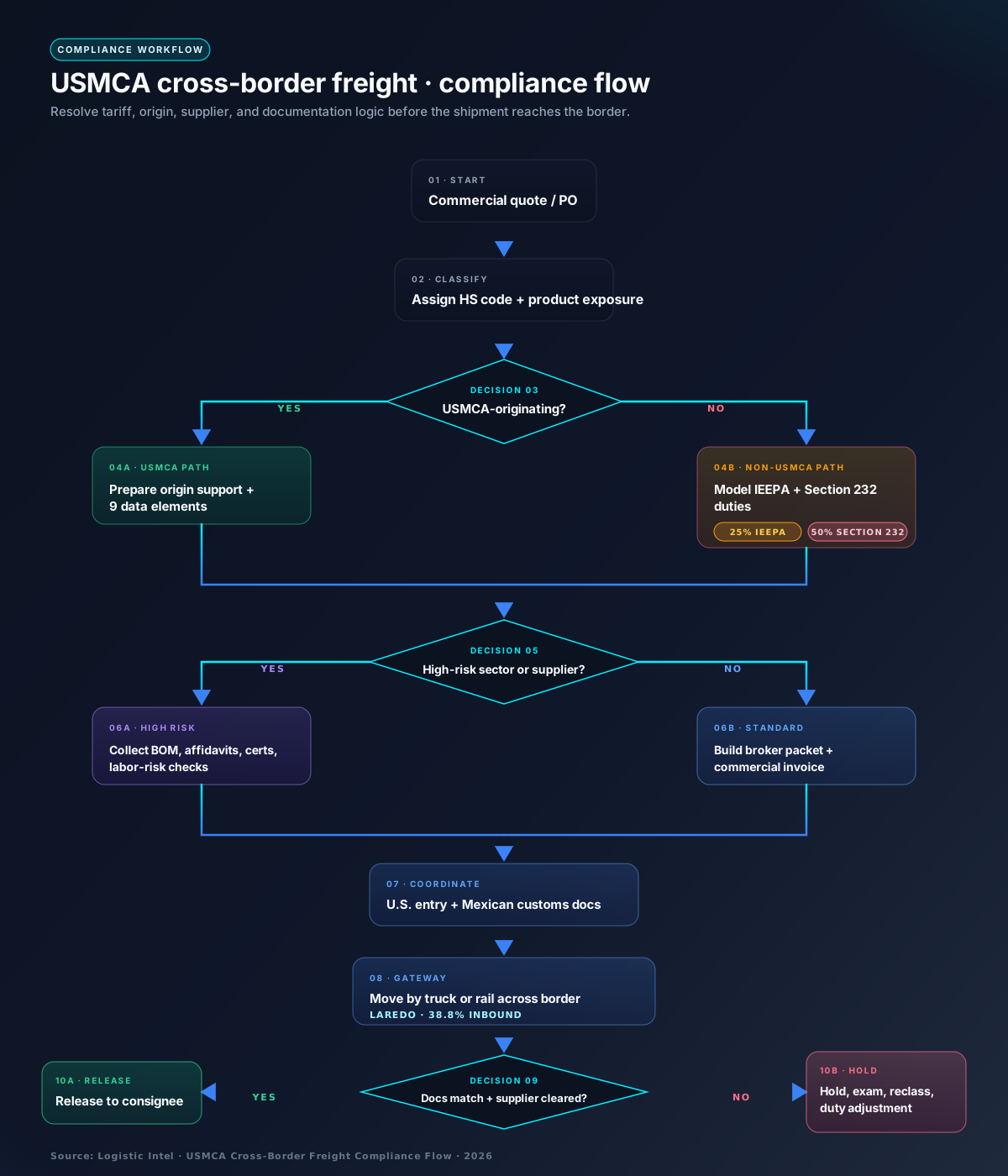
The workflow reflects the core operating model for 2026: resolve tariff, origin, supplier, and documentation logic before the shipment reaches the border.
Risks, Opportunities, and the LIT Sales Angle
Where the risk concentrates
The biggest commercial risks sit in sectors with large non-North-American input shares or direct sectoral tariff exposure: auto parts, steel and aluminum derivatives, machinery, appliances, electronics, textiles, certain chemicals, and fuel-linked logistics.
Where the opportunity sits
The clearest opportunities are the mirror image of those risks: suppliers of North American qualifying inputs, customs and origin-advisory providers, near-border warehousing and transload operators, and carriers or 3PLs that can pair capacity with documentation discipline. Mexico remains the United States' largest goods-trade partner, the lane remains truck-heavy, and the review is increasing the value of service providers who can explain why one shipment clears at 0% while another gets repriced, delayed, or re-routed.
Target shippers for whom a one-day border delay, a failed origin claim, or a higher-duty statute would materially change gross margin.
How Logistic Intel fits this moment
Logistic Intel acts as a commercial research layer over the 2026 cross-border opportunity:
- Identify importers, exporters, OEMs, contract manufacturers, and distributors moving exposed U.S.-Mexico categories.
- Prioritize by product mix, lane concentration, and likely origin or tariff exposure.
- Enrich those accounts with verified contacts in procurement, customs, logistics, and trade compliance.
- Launch outreach built around a concrete pain point — USMCA requalification, Section 232 exposure, border-buffer inventory planning, or supplier reshoring.
Sources
USTR — USMCA and Chapter 34 final provisions; USTR launch-of-review and bilateral-discussion releases; USTR/Ebrard joint statement; Reuters coverage of the first negotiating round (May 22, 2026) and the Mexico-EU trade deal (May 22, 2026); Reuters coverage of Greer on tariffs (April 21, 2026); White House Canada/Mexico tariff framework under IEEPA and Section 232 steel/aluminum actions; CBP USMCA FAQs and IEEPA FAQ; USTR USMCA Autos and Auto Parts fact sheet; BTS Transborder Freight Data Annual Report 2025 and Border Crossing Data 2025; USTR Mexico country summary and 2026 National Trade Estimate Report; ITA on Mexico Customs Law Reform; USTR Greer Report to Congress on USMCA Operation; USTR Rapid Response Labor Mechanism (Faurecia); Mexico Secretaria de Economia; ANAM import requirements; FMCSA Mexico Long-Haul Program.

Sarah Kim
Trade-data analyst at LIT. Spends her days inside 124M+ Bill of Lading records looking for the lane shifts, carrier pivots, and importer cohorts that matter to freight sales teams. Previously analyzed supply-chain data at a major freight intelligence platform. Writes the data-led posts on the LIT blog — cohort analyses, lane outlooks, and primary-source breakdowns.